


Artificial intelligence has arrived in project management with the confidence of someone who read half the brief and decided that was enough.
Some people see it as the Stairway to Heaven.
Others see it as the Road to Hell.

As a lazy project manager, and I mean that in the most professional sense possible, I see it as both, and as I explored in my new book ‘The Invisible Project Manager’ the real question is not whether AI is good or bad but whether it helps the project manager disappear in the right way.
Let’s start with the promise.
The Stairway to Heaven is about aspiration, it is about the belief that there is a better place and that we can reach it if we just follow the right path. AI offers exactly that vision to project managers, tools that automatically update schedules, predict risks generate reports, and track progress, all promise to remove the heavy lifting that fills our days and adds very little value. This is the heaven that AI sells with less admin and fewer meetings more time to think.
For the lazy project manager this sounds perfect.
In my book I argue that great project managers will become invisible. AI can support this beautifully, if the system can spot a slipping dependency before the team feels it or flags a risk before it becomes a crisis then the project manager does not need to stress or, perhaps, even be there at all.
That is the Stairway to Heaven when AI becomes the silent assistant that lets the project manager focus on outcomes not spreadsheets.
There is also a human benefit that is often overlooked. When AI handles reporting and tracking the project manager has more time to build trust coach stakeholders and actually lead. These are the things that never appear in a status report but determine success. AI does not replace judgement empathy or experience. It creates space for them and used well it allows the project manager to become more human, not less.
But then there is the ‘Road to Hell’.
And as Chris Rea reminds us it is paved with good intentions. The danger with AI in project management is not that it is clever but that it is convincing. Dashboards look confident forecasts look precise and recommendations look authoritative, the risk is that project managers stop thinking, they blindly follow the tool rather than the truth. They become visible again but all for the wrong reasons, because when it goes wrong it goes wrong big time.
‘The Invisible Project Manager’ warns against blind process and blind dependency of tools. The danger is that AI can accelerate both. If the underlying data is poor then the output will be poor, if the context is wrong then the recommendations will mislead. AI does not understand politics, culture or fear. It does not know that a task is late because someone is caring for a sick parent or that a stakeholder is blocking progress because they feel ignored. When project managers trust AI more than their own insight, they step onto the ‘Road to Hell’ slowly and politely.
There is also the temptation to automate leadership, and this is where things can get dangerous. Sending AI generated updates replacing conversations with bots and allowing algorithms to decide priorities may look efficient but it strips the project of connection. In my experience projects fail not because of poor plans but because of poor relationships and AI cannot fix that. In fact, it can make it worse by giving the illusion that everything is under control.
The lazy project manager is not lazy because they do nothing. They are productively lazy because they refuse to do the wrong things. AI should be used with the same discipline. Use it to remove waste not responsibility, use it to inform decisions not replace them, and use it to stay invisible by enabling the team not by hiding behind technology.
So where does that leave us.
Somewhere between heaven and hell which is where most projects live anyway.
AI is a powerful amplifier, and it will amplify good project management (which si good) and it will amplify bad project management (which is terrible) and it will not save you from yourself.
‘The Stairway to Heaven’ is not built by technology alone, it is built by intent judgement and trust.
‘The Road to Hell’ is not caused by AI, it is caused by surrendering thinking in exchange for convenience.
‘The Invisible Project Manager’ approach still holds.
- Be present without being noisy
- Be informed without being controlled
- Be lazy enough to automate the trivial and brave enough to own the important
AI can help you do that if you remember who is in charge. The tool or the project manager.
And if you get that balance right then perhaps AI really can be a ‘Stairway to Heaven’. Just keep an eye on the road signs along the way, the ‘Road to Hell’ is also just over the horizon.
Inspired by two epic songs:
- Stairway to Heaven by Lez Zeppelin
- The Road to Hell by the late Chris Rea
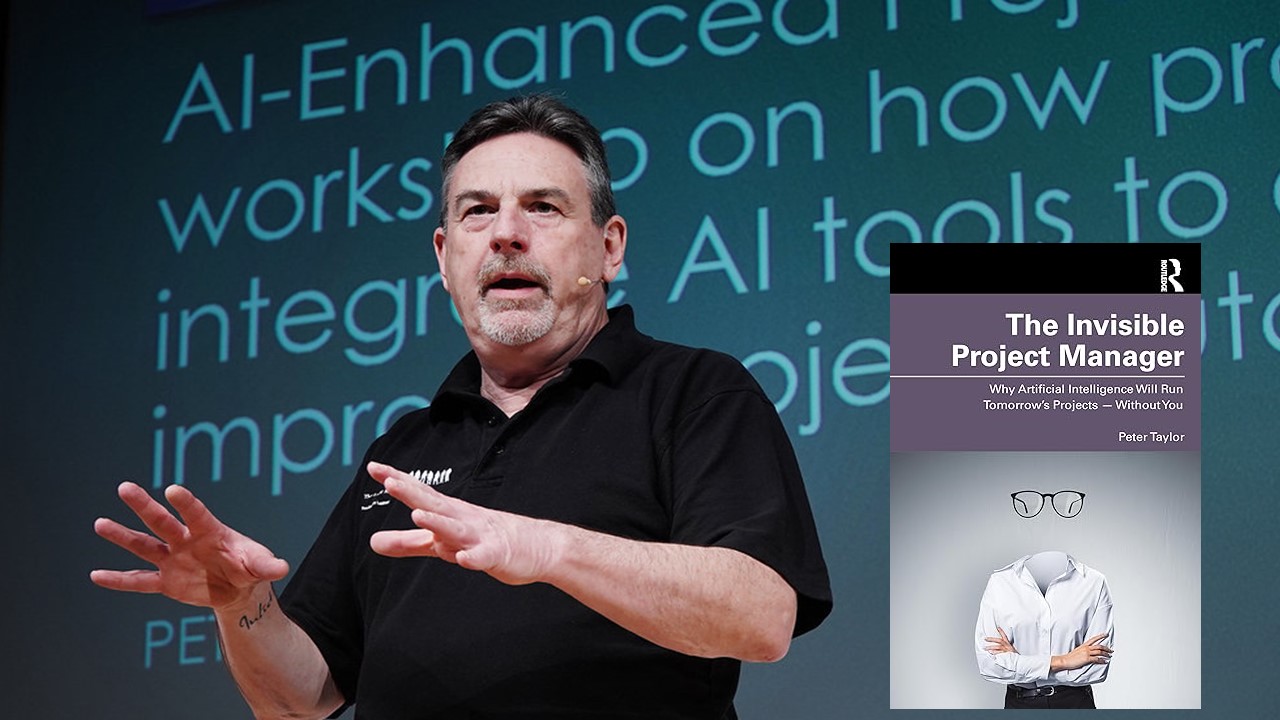
The Invisible Project Manager: Why Artificial Intelligence Will Run Tomorrow’s Projects ― Without You

What if the best project manager didn’t exist? In this provocative and future-facing manifesto, Peter Taylor, the original Lazy Project Manager, asks uncomfortable questions about the impact on his profession from the inexorable rise of artificial intelligence.
Traditional project management has created a substantial legacy, but what if project managers aren’t evolving but evaporating? What if success no longer needs a command-and-control human hero at the helm? Thanks to the power of AI, the next generation of project delivery won’t be managed, it will be orchestrated, seamlessly, silently, invisibly. It just might be the end of project management as we know it and the beginning of something radically smarter – but humans will still be very much involved, and this book explains how. It defines the ‘Invisible Project Manager’ future where AI systems manage workflows, timelines, and resources, while the ‘human-in-the-loop’ will be a vastly different skillset moving from the managers of activities to guardians of outcome. Accelerated change to the project management profession is arriving soon, and at speed.
This book is an essential and thought-provoking guide to evolution for forward-looking leaders, digital transformation strategists, and change agents who are planning for the long game. Are you ready to disappear?
Peter Taylor
Keynote speaker and coach, Peter is the author of the number 1 bestselling project management book ‘The Lazy Winning Project Manager’, along with many other books.
He has built and led some of the largest PMOs in the world, now with Dayforce, where he is the VP Global PMO.
He has also delivered over 500 lectures around the world in 28 countries and has been described as ‘perhaps the most entertaining and inspiring speaker in the project management world today’.
http://www.thelazyprojectmanager.com
#ProjectManagement
#AIinProjectManagement
#TheInvisibleProjectManager
#Leadership
#FutureOfWork
#LazyProjectManager
#ArtificialIntelligence
#AIatWork
#HumanCenteredAI
#DigitalLeadership
#ModernProjectManagement
#ThoughtLeadership
#ProjectLeadership
#LeadershipLessons
#WorkSmarter
#ManagementThinking
#ChangeManagement
#Transformation
#Delivery
#PMCommunity
#ContinuousImprovement
Tags: #ai, #technology, artificial intelligence, chatgpt, writing