


Why Knowledge Transfer Determines Project Success
Energy and infrastructure projects are getting larger, more complex, and more expensive. Yet project success rates have barely improved in decades.
Why?
Because project strategies are often treated as plug-and-play. The same governance structures, management frameworks, and procedures are applied regardless of scale.
But scale changes everything:
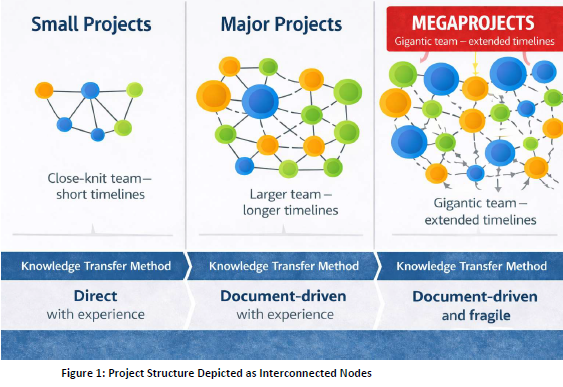
- Small projects rely on a few experienced people who share context and institutional memory. Communication is direct, decisions happen quickly, and knowledge moves naturally within the team.
- Project success depends largely on the experience of a few individuals.
- Major projects involve larger teams, longer timelines, and broader scopes. Procedures become necessary to coordinate work and maintain consistency across the project.
- Project success increasingly depends on clear documentation and disciplined processes.
- Megaprojects operate across multiple organizations, disciplines, and documentation environments. Teams work in silos. Workforce turnover occurs across multi-year project schedules. Critical decisions are often made by people who were not present when the original assumptions were developed.
- At this scale, project success becomes fragile because knowledge fragments across the system.
Lessons from previous projects are rarely transferred effectively. Even within the same project, procedures often begin incomplete and evolve as teams capture practical knowledge during execution.
Without structured knowledge transfer, experience becomes isolated and future projects repeat the same costly mistakes.
This matters because the industry faces more than $57 trillion in global infrastructure demand by 2030.
The problem is not a lack of certifications, frameworks, or methodologies. The problem is that critical project knowledge is rarely structured so that it can move reliably across teams, organizations, and future projects.
Improving project success requires structured knowledge transfer systems.
This is the gap KT Project was created to address. KT Project develops practical tools, structured guidance, and knowledge resources designed to preserve and transfer the lessons that complex projects cannot afford to lose.
Because if knowledge is not structured, it is not transferable.
Artificial intelligence tools were used to assist with early drafting of this article and image. The final content was reviewed, refined, and approved by the author.