

Let’s be honest, not every PMO is operating as a strategic partner yet. While some have made that shift, many are still stuck being seen as administrative, compliance-heavy, or simply “the reporting function”. And in plenty of organisations, PMOs are still having to fight hard to prove their worth, relevance, and right to exist.
At the House of PMO, we spend a lot of time listening, through conversations with members, events, roundtables, training, and the day-to-day challenges PMO professionals bring to us. What we see isn’t a neat, linear evolution. It’s progress mixed with frustration, ambition mixed with constraint, and a strong desire to do better within very real organisational limits.
This trends report reflects that reality.
The ten trends that follow are based on what PMOs are actively working on right now – what’s gaining momentum, what’s starting to change, and where effort is being focused.
Think of these trends less as a celebration of where PMOs already are, and more as signposts for where attention is needed next. They’re prompts for reflection, conversation, and action – whether your PMO is well-established, newly formed, or somewhere in between.
There’s still plenty of work to do. But the direction of travel is becoming clearer.
Across the PMO community, there’s no single “right” model but there are some very clear patterns emerging. PMOs are under pressure to justify their existence, simplify what they do, and focus much more deliberately on value (or benefits), not activity.
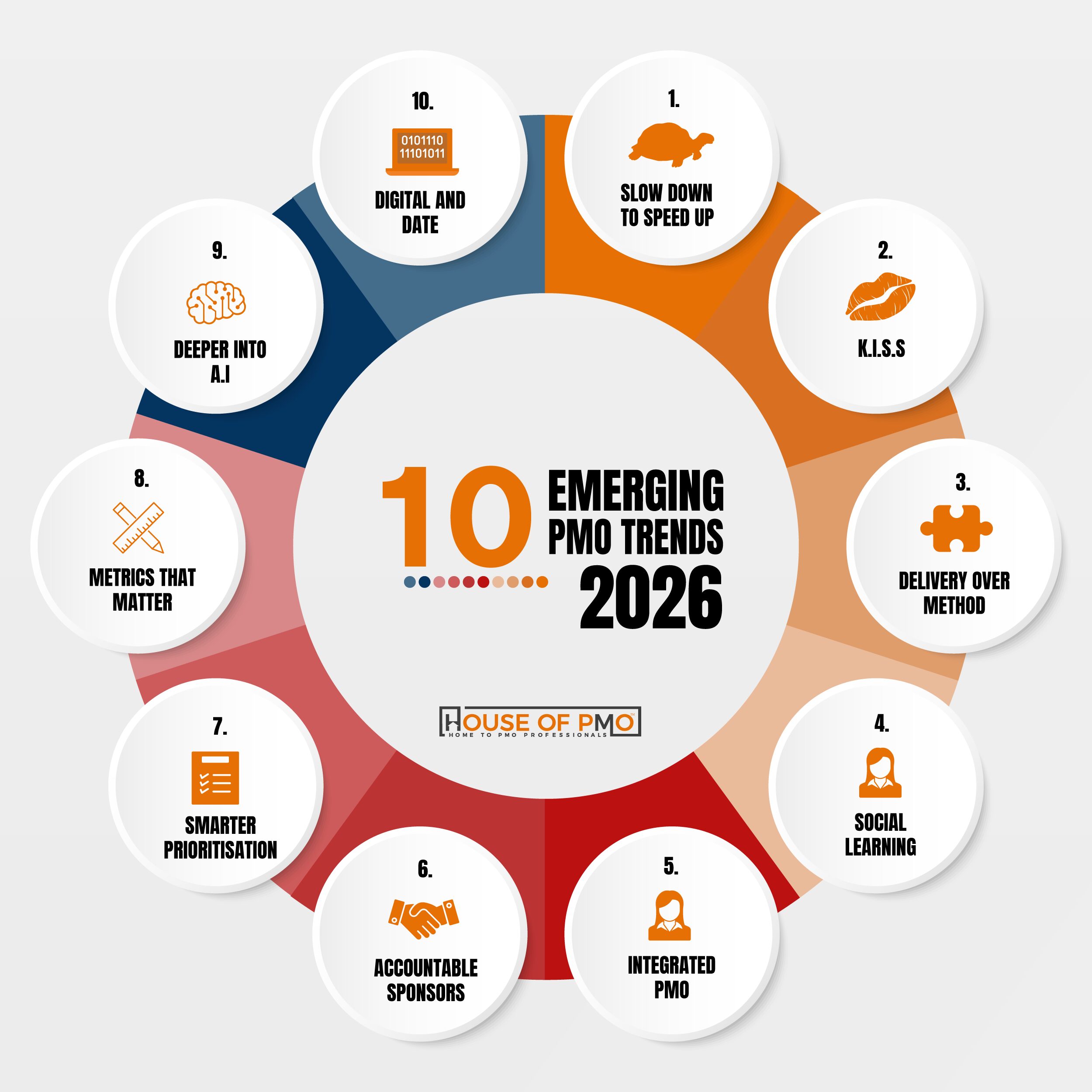
The ten trends below reflect that shift. They’re not about new frameworks or transformation. They’re about PMOs making smarter choices, tightening their focus, and doing fewer things better.
- Slow Down to Speed Up (The Power of Stage 0)
- Engaging Sponsors as Accountable Leaders
- Deeper into AI and Automation
- Metrics That Matter (Proving PMO Value)
- Keep It Simple, Seriously (KISS)
- Digital and Data-Driven PMO
- Smarter Prioritisation
- “Over Methods” – Delivery Above Methodology Labels
- Social Learning on the Rise
- Continued Integration of PMOs as Strategic Partners
 Slow Down to Speed Up (The Power of Stage 0)
One of the most powerful trends we’re seeing is the strategic tactic of slowing down at the very beginning of the project lifecycle. The most effective PMOs are learning that a deliberate, rigorous investment in pre-project activities – what we’re calling “Stage 0” – is the single best way to ensure projects have a greater chance of success later down the line.
What we find particularly powerful about this is that it isn’t about creating bureaucracy for its own sake. It’s about ensuring that only the right projects, with the right foundations, ever make it to the starting line.
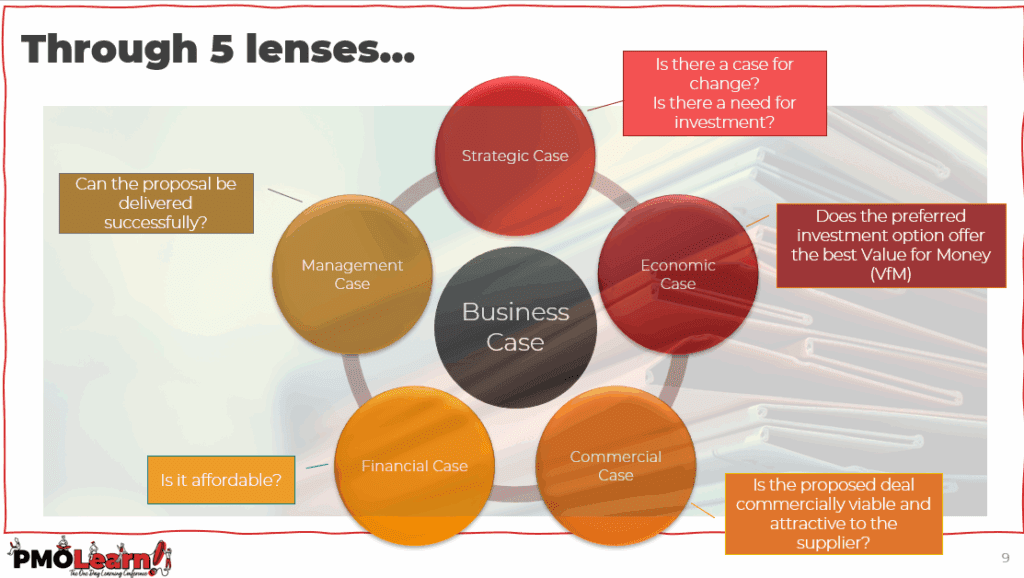
As we saw at the PMO Conference in Edinburgh in 2025, Carol Hindley-Baxter in her PMOLearn! session about optioneering from “Better Business Cases,” Stage 0 is where the strengthening of the core proposition of the potential project takes place.
Using approaches like the Better Business Cases Options Framework, PMOs are helping organisations explore choices across scope, solution, delivery, implementation, and funding – before money and people are added into the mix. This makes trade-offs visible early and helps challenge “pet projects” with evidence rather than opinion.
We also saw a practical example of Stage 0 in action, earlier in the year when Louise Barker from Pennine Care NHS Foundation Trust shared her approach of the “Stage Zero Triage Process” and the difference it has made to delivery. [You can see that session here – Making Change Stick]
When Stage 0 is done well, it reduces risk, speeds up delivery overall, and gives the PMO a far stronger footing in strategic conversations. But even the best business case won’t succeed without the right leadership behind it.
 Engaging Sponsors as Accountable Leaders
Poor sponsorship remains one of the most common causes of project failure and PMOs are no longer pretending this is someone else’s problem.
For 2026, we’re seeing PMOs take a much more active role in shaping sponsor behaviour. That doesn’t mean “training executives to be project managers”. It means helping them understand what good sponsorship actually looks like in practice.
Insights from events like our Blue Light PMO Summit show how PMOs are tackling this with creativity and pragmatism. We’re seeing several techniques that are working well:
- Educating and Coaching: PMOs are providing brief training, one-on-one coaching, and simple orientation sessions for Senior Responsible Owners (SROs). This helps clarify their role, define their decision rights, and articulate how they can be an effective sponsor.
- Defining Accountability: A simple but powerful step is “pinning down” the single, true sponsor for each initiative. This avoids the diluted responsibility that comes with sponsorship by committee and creates a clear point of accountability.
- Making Engagement Easy: Recognising that senior leaders are incredibly busy, PMOs are streamlining how they communicate. They are providing concise, decision-focused reports and explicit decision frameworks (e.g., “At this stage gate, you need to decide X or Y”) that make it easy for executives to engage meaningfully without getting lost in the details.
The shift here is important. PMOs are acting as critical friends – using evidence, insight, and structure to support better leadership decisions. When sponsorship improves, delivery improves. And the PMO’s credibility improves with it.
If you would like to learn more about the findings and insights from the Blue Light PMO Summit – join us in February 2026 [register now]

 Deeper into AI and Automation
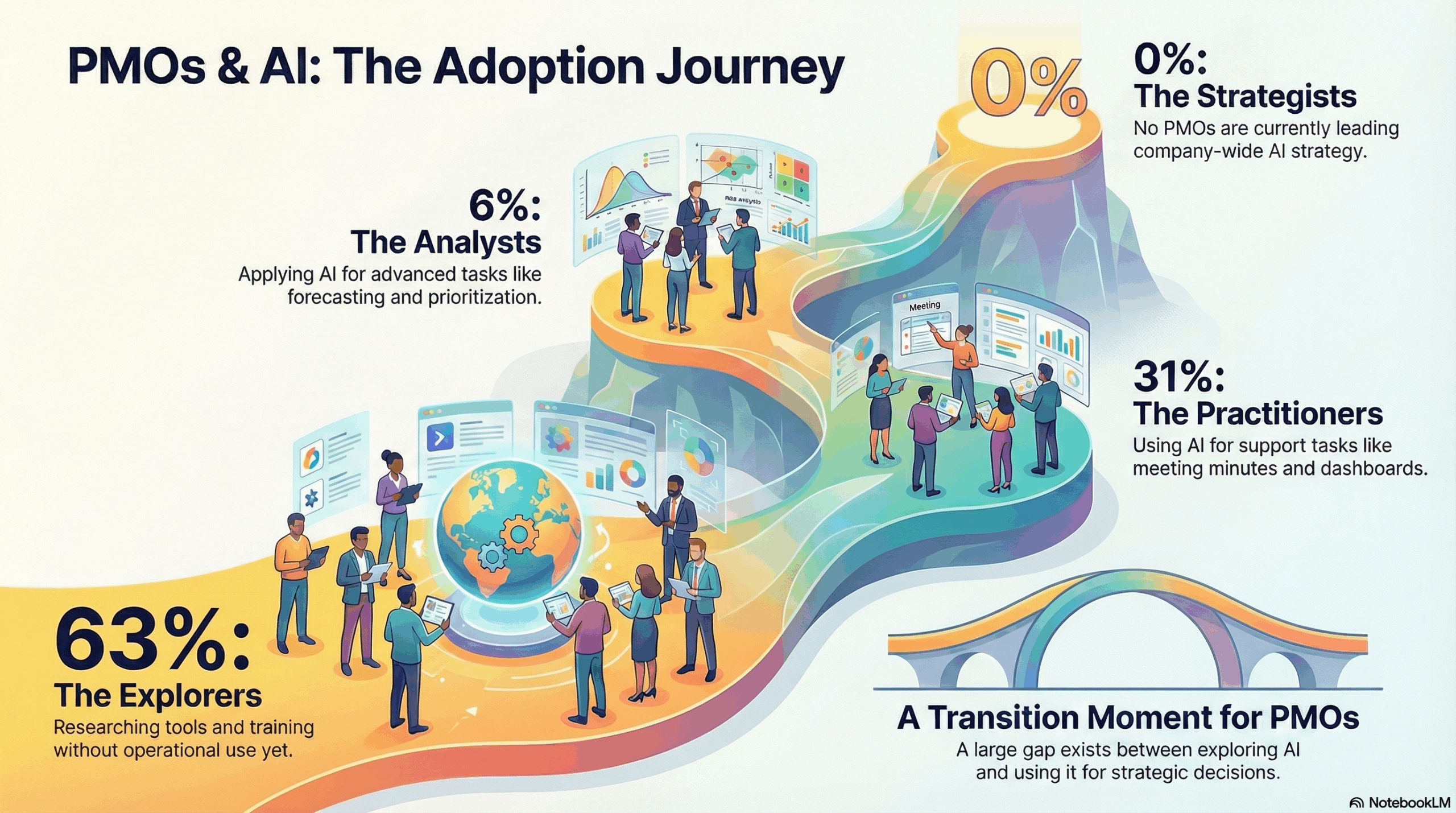
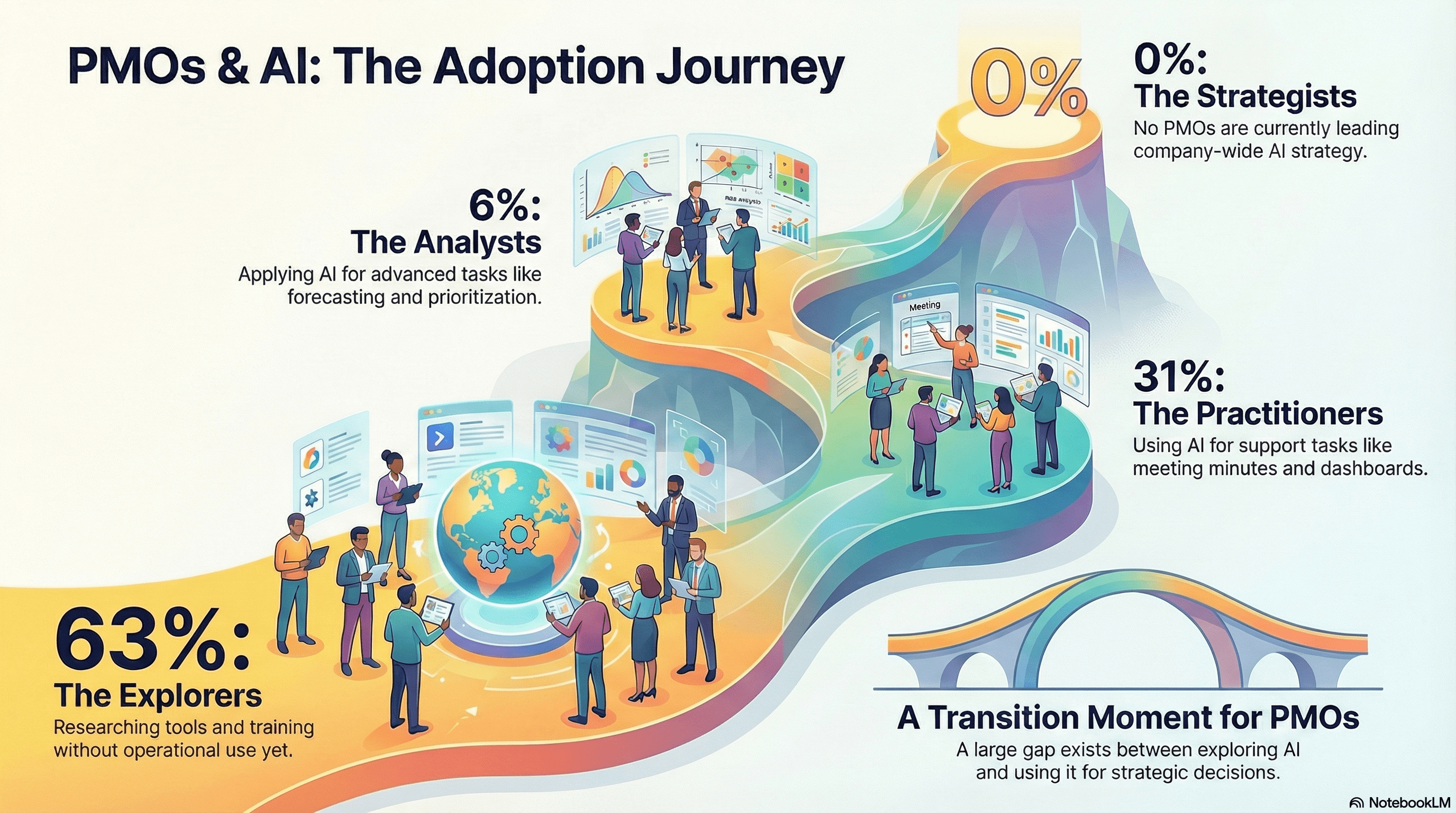
Not long ago, the conversation around Artificial Intelligence in our community was tinged with apprehension. We’re thrilled to see that this has given way to active exploration and genuine excitement. We’re seeing PMOs increasingly view AI not as a threat, engaging with it in realistic, low-risk ways.
As we’ve seen in presentations from experts like Michael Campbell (speaking at the recent PMO Conference), emerging use cases are moving from the theoretical to the practical. Concepts like MLOps (Machine Learning Operations) and “agent frameworks” are becoming tangible aids that can help with everything from predictive analysis to automating routine project tasks.
On the ground, many PMOs are taking a sensible, pilot-based approach. The Blue Light PMO Summit highlighted that many are starting with automating reporting, exploring AI features already built into tools, and using generative AI to support analysis, summaries, and decision prep.
This trend is about more than just technology; it’s a call for a new mindset.
PMO teams are beginning to see AI as a way to reduce low-value admin and free up time for thinking, analysis, and conversation. That requires curiosity, confidence with data, and a willingness to test and learn rather than wait for perfect answers.
AI doesn’t replace PMO judgement. It amplifies it but only if the data underneath is sound and the questions being asked actually matter.
 Metrics That Matter (Proving PMO Value)
For many PMOs, reporting is still heavy on activity and light on impact. That’s no longer sustainable.
In 2026, the focus is firmly on metrics that senior leaders actually care about – financial outcomes, risk reduction, delivery confidence, and strategic alignment.
We’re seeing PMOs move away from dashboards full of red-amber-green and towards a small number of outcome-based measures that clearly link PMO effort to business results. Annual value reports are becoming more common, translating delivery success into things like cost avoided, benefits realised, or margin protected.
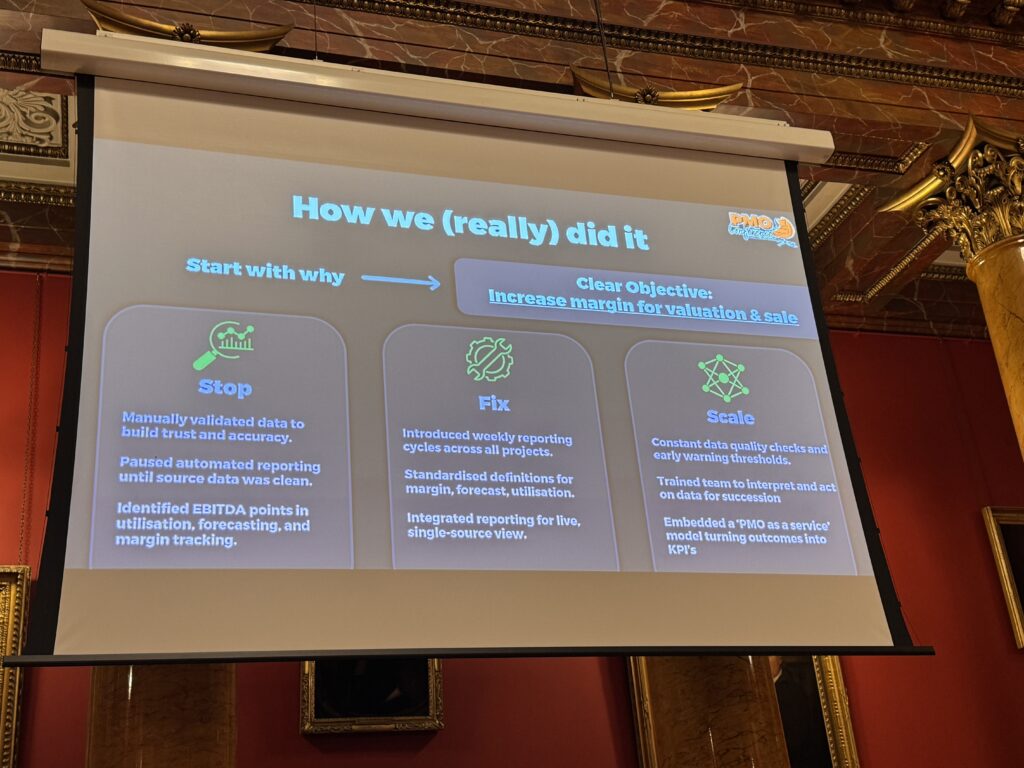
Michael Campbell’s case study at the PMO Conference of the tech consultancy Unifii provides a perfect, hard-hitting example of a metric that truly matters. By focusing the PMO’s efforts on a clear business outcome, his team was able to report a tangible, C-suite-level result:
“Margin from 39% > 47% 6 months prior to valuation”
This is the kind of metric that stops executives in their tracks. It’s not about how many projects were completed or how many reports were issued; it’s about the direct, measurable impact the PMO’s work had on the business’s financial health and enterprise value.
The challenge here isn’t finding metrics. It’s having the confidence to stop reporting on things that don’t matter.
The most effective PMOs are ruthless about this – fewer measures, clearer narratives, and a direct line of sight to organisational priorities.
This also aligns perfectly with the theme of “Value for Money” from our Blue Light PMO Summit, where we saw PMOs creating annual “value reports.” These reports don’t just list completed projects; they translate successes into concrete business outcomes – money saved, risks mitigated, strategic goals achieved. The focus must be on making an undeniable link between the PMO’s efforts and the organisation’s most important objectives, because the clearest metrics and reports are often the simplest.
 Keep It Simple, Seriously (KISS)
For 2026, there’s a clear push back towards simplicity. Not because rigour isn’t important, but because unused processes deliver no value at all.
We’re seeing the most mature PMOs find a new competitive advantage in simplicity. By streamlining processes, clarifying governance, and reducing bureaucratic friction, they are making it easier for teams to do good work and for stakeholders to engage.
The advice we heard loud and clear at many of the in-person events this year was to “avoid overengineering.”
PMOs are simplifying governance, shortening templates, and scaling controls based on risk and complexity rather than applying the same approach to everything.
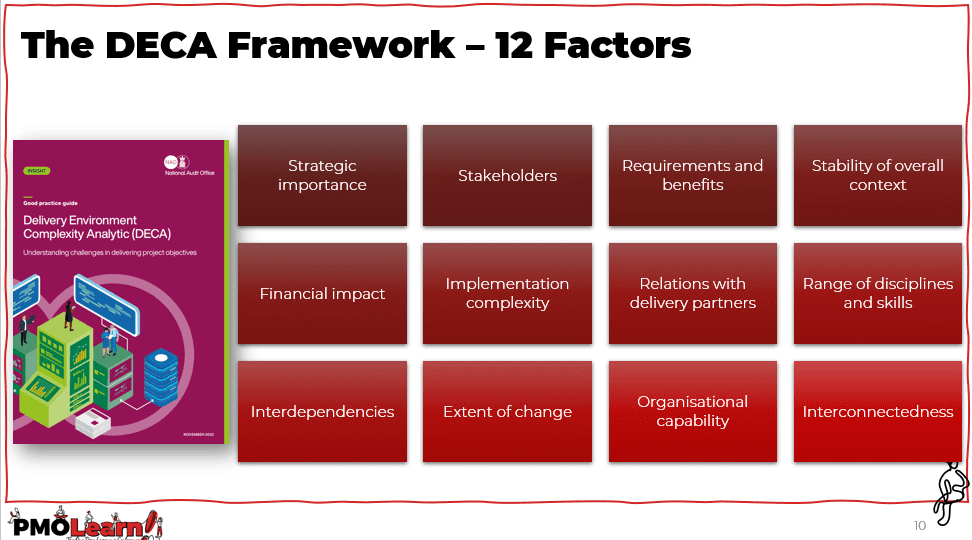
Tools like complexity assessments (another session at PMOLearn! in 2025) help determine how much governance is genuinely needed – from lightweight oversight to more structured control. This right-sizing of governance manifests in shorter reports, clearer dashboards, and lightweight templates that people will actually use. Simplicity reduces noise and allows everyone to focus on what matters: delivery.
The principle is straightforward: make it easier for people to do the right thing. When processes are clear, proportionate, and usable, engagement improves and resistance drops.
Plus, the words – simple and clarity – might just be our words of the year!
 Digital and Data-Driven PMO
The ambition to be “data-driven” is everywhere. The reality is harder.
PMOs are learning that dashboards don’t fix poor data and tools don’t create insight on their own. Before digital PMOs can work, data discipline has to come first.
That means agreeing what data matters, establishing a reliable cadence for collecting it, and validating it before it’s automated. PMO roles are shifting away from chasing updates and towards analysing patterns, trends, and implications.
Direction for 2026 must include:
- Build a Cadence before a Dashboard: Don’t rush to automate. First, establish a reliable, manual rhythm of collecting, validating, and reviewing data. This builds trust and ensures the data is accurate before you build a dashboard on top of it.
- Grow Analysts, Not Admins: The PMO’s role must shift from chasing data to interpreting it. Team members need to become analysts who can spot trends, ask “why,” and turn raw data into actionable insights for leaders.
- Cross-Check Everything: Never trust a single data source. A truly data-driven PMO triangulates information from multiple systems – finance, project tools, sales – to verify its accuracy and build a complete picture before presenting it for decision-making.
The goal isn’t control. It’s confidence – confidence that decisions are based on something solid, not assumptions or anecdotes. And that confidence feeds directly into better prioritisation.
 Smarter Prioritisation
“Everything is a priority” remains one of the biggest problems when trying to prioritise projects and programmes in a portfolio.
Many of us have seen simplistic High/Medium/Low rating systems fail, as “everything defaulted to high.” PMOs are responding by introducing clearer, more objective prioritisation approaches. Multi-criteria scoring, benefits-versus-effort assessments, MoSCoW techniques, and capacity-led planning are all being used to force real trade-offs.
A notable shift here is resource-first thinking. Instead of starting with “What should we do?” the more practical question becomes, “What can we actually deliver with the people and skills we have?”
What we find so exciting here is how PMOs are using portfolio heatmaps and real-time capacity data to bring this concept to life. These tools provide visual evidence of resource bottlenecks and overloaded teams, forcing leadership to move from abstract prioritisation to making concrete, data-driven decisions.
They make the consequences of overload impossible to ignore, helping everyone embrace the motto “stop starting, start finishing.” And just as PMOs are becoming more pragmatic about prioritisation, they are also becoming more pragmatic about delivery methodologies.
 “Over Methods” – Delivery Above Methodology Labels
Methodology debates are losing relevance and that’s a good thing.
PMOs are becoming far more practical and precise when it comes to project approaches. Hybrid approaches are now the norm, not the exception, combining governance where it’s needed with flexibility where it helps.
What matters is intent. PMOs are deliberately designing approaches that fit the work, the risk, and the environment and not forcing projects into predefined boxes.
This maturity shows up in layered models, phased approaches, and different delivery styles running side by side.
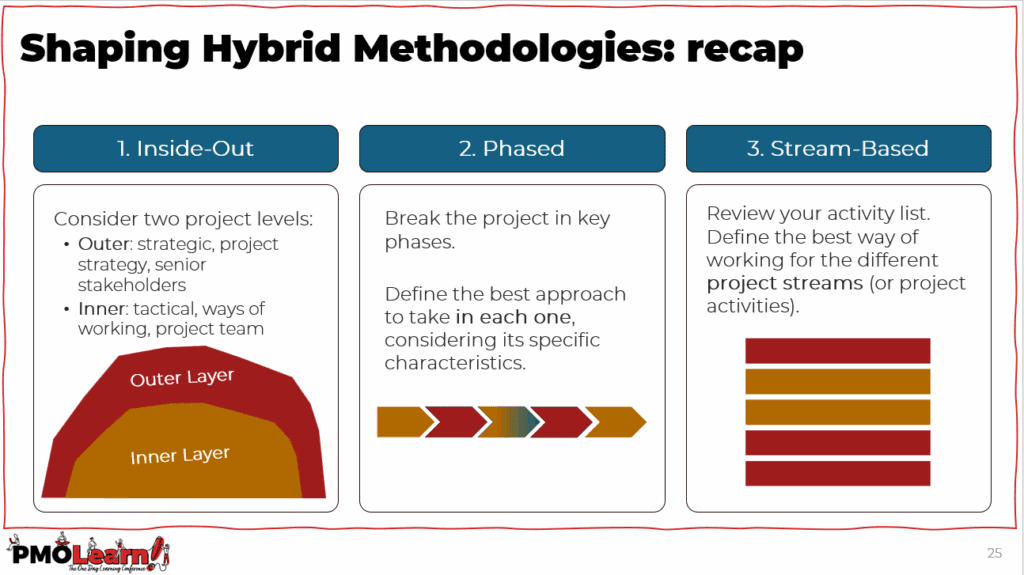
As Ivan Vaptsarov’s work (PMOLearn! in Edinburgh this year) on hybrid methods illustrates, this is about intentionally borrowing “bits of this/bits of that” to create a fit-for-purpose approach. We’re seeing this play out in a two-layer model. The outer layer is strategic, encompassing project governance and key control points. The inner layer is tactical, defining how teams work day-to-day. This allows for central oversight where it matters, while giving delivery teams the flexibility they need.
We are seeing PMOs deliberately design their hybrid approaches using a few common patterns:
- Inside-Out: Setting the core governance needs first, and then tailoring team practices to fit within that framework.
- Phased: Adapting the delivery approach as the project moves through its lifecycle and uncertainty decreases (e.g., from an exploratory phase to a more structured delivery phase).
- Stream-Based: Running different approaches in parallel for different workstreams within the same project (e.g., a waterfall approach for a vendor-led stream and an agile approach for an internal marketing campaign).
It’s structured without being rigid, and flexible without being chaotic.
 Social Learning on the Rise
Formal training still has its place but it’s no longer enough on its own.
PMOs are placing much more emphasis on social learning: mentoring, peer reviews, communities of practice, and shared problem-solving. Learning is happening through conversation, experience, and reflection, not just courses.
The traditional 70/20/10 learning model (where 70% of learning is experiential, 20% is social, and 10% is formal) feels increasingly outdated. Many in our community feel a revised model, perhaps closer to 65/35/10, better reflects today’s reality, placing a much greater emphasis on learning with and from others.
As we heard in one of our roundtable discussions, there is immense value in simply “comparing scars” with a peer. This shift recognises a simple truth – much of what PMO professionals need to know can’t be learned from slides. It’s learned by talking to others, seeing how things really work, and sharing what went wrong as well as what went right.
Stronger capability grows from stronger connections.
 Continued Integration of PMOs as Strategic Partners
This final trend is really the culmination of all the others and something the House of PMO set out a couple of years ago with “The PMO as a Business Function“.
PMOs are increasingly being embedded into business areas rather than operating as a distant central function. This proximity builds trust, improves understanding, and allows PMOs to influence decisions earlier – where they can actually make a difference.
In this role, the PMO acts as a connector: between strategy and delivery, between different delivery models, and between governance and pace. Accountability shifts from managing projects to improving the organisation’s overall ability to deliver change.
Not every PMO is there yet. But the direction is clear.
The PMO of 2026 isn’t defined by tools, templates, or titles. It’s defined by choices – what to focus on, what to simplify, and where to add real value.
These trends don’t represent a finished state. They reflect an ongoing shift towards PMOs that are more grounded, more people-centred, and more aligned to how organisations actually work.
There’s still work to do. But there’s also clarity about where effort matters most.
And that’s a good place to be.