

Resource management has always been one of the toughest challenges for PMOs and in 2025, it’s only become more complex. Between hybrid working, ongoing skill shortages, shifting priorities, and leaner budgets, PMOs are under more pressure than ever to make sure the right people with the right skills are available at the right time.
That reality was front and centre in the latest Inside PMO: The Circle of Resource Management report, a refreshed model developed from roundtable sessions hosted at the Houses of Parliament. The discussions brought together PMO leaders from government, finance, construction, and digital delivery – all keen to tackle the same question: how do we plan, prioritise, and deliver work when demand always outpaces capacity?
“We used to ask if we had enough people to deliver the plan. Now, it’s about whether we’ve got the right people, with the right skills, ready at the right time.”
Revisiting the Circle
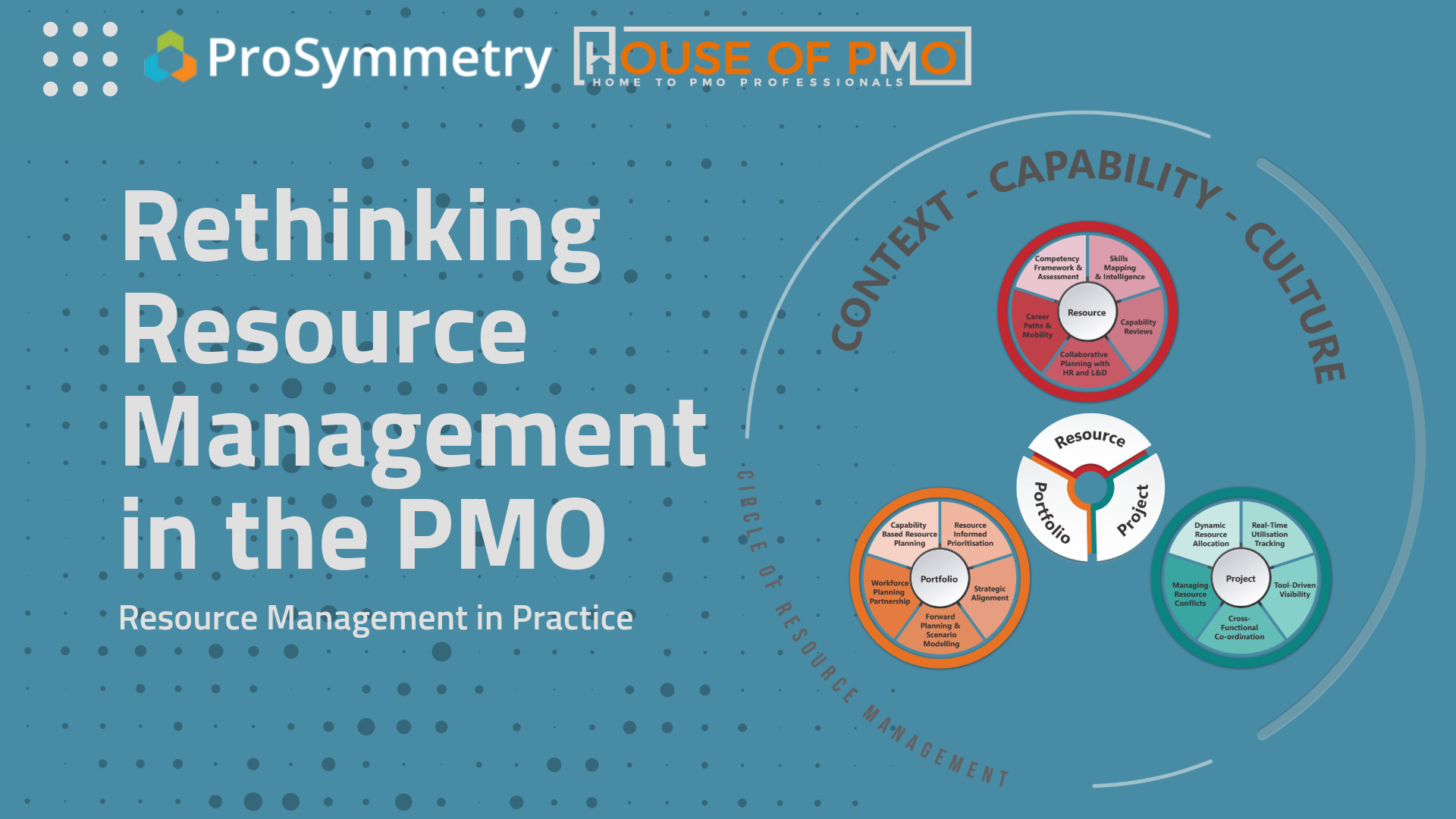
The Circle of Resource Management model, first developed back in 2017, still stands strong but it’s evolved. It’s built around three interconnected segments: Portfolio, Project, and Resource, all surrounded by the organisation’s context, culture, and capability.
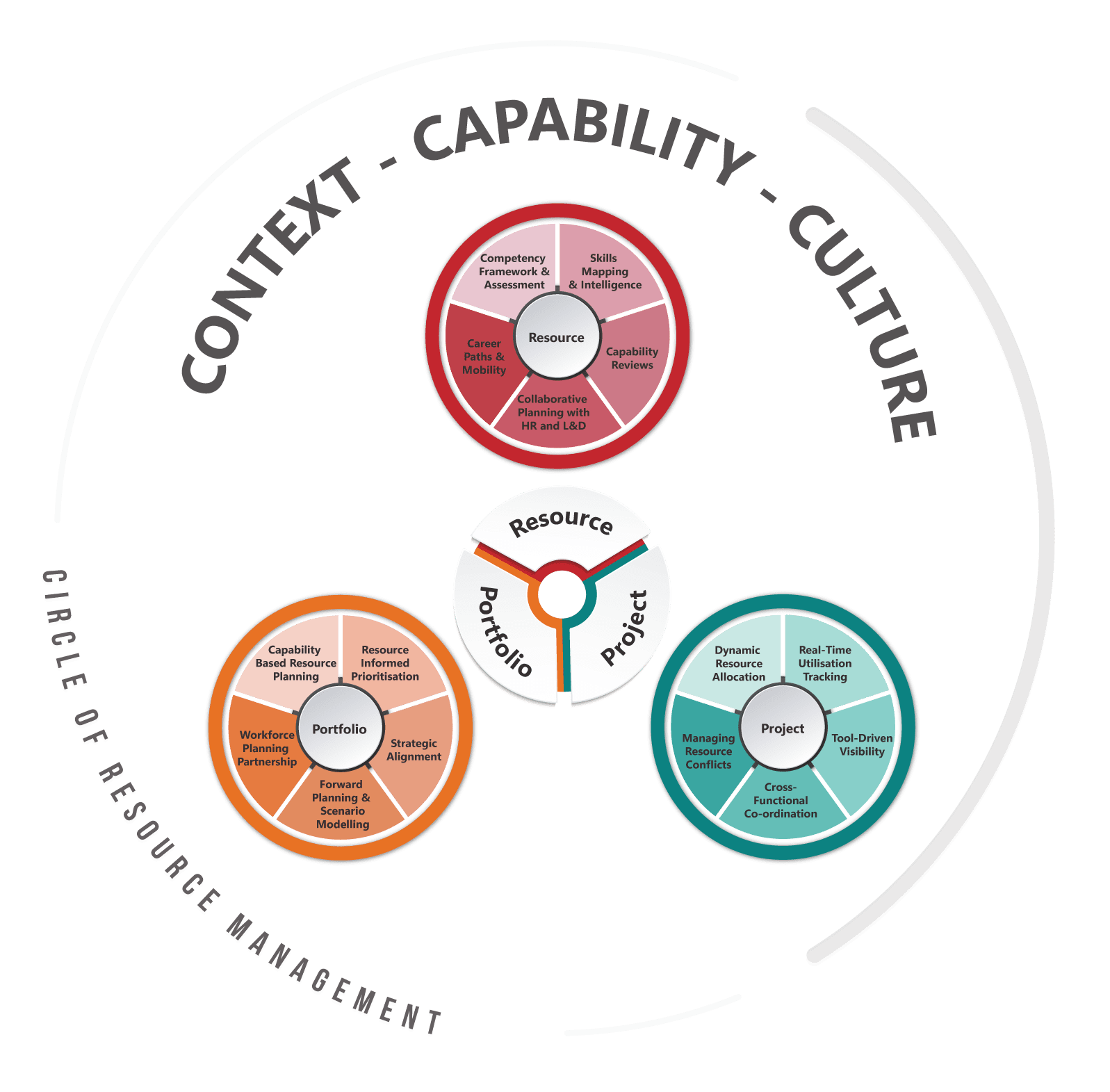
It recognises that effective resource management isn’t just a process – it’s a system of connected parts. The portfolio decides what work should happen, projects manage how it gets done, and the resource layer focuses on who does it and how they grow.
As the report highlights, culture and capability now form a vital outer ring. Without skilled people, supportive culture, and clear context, even the smartest process or tool won’t stick. As one participant put it:
“When business drivers and context are fully understood, then you can start to develop the processes and raise the maturity.”
From Headcount to Capability
Across the board, PMOs are moving away from headcount-based planning and towards capability-based forecasting – a shift from quantity to quality. Instead of asking “how many project managers do we have?”, the question becomes “what skills and competencies do our teams actually bring?”
This shift is changing how portfolios are prioritised. Projects are no longer approved purely on business case strength; they’re being challenged on whether the organisation has the capacity and capability to deliver them. It’s helping leadership make smarter, data-driven trade-offs when the pipeline is full but the talent pool isn’t.
One NHS Trust shared how they tackled this problem by introducing a skills inventory alongside capacity planning. By mapping skills across the organisation, they could match people to the right projects, spot skill shortages earlier, and even justify investment in new roles or training. Within a year, they saw improved delivery outcomes and less burnout – not by hiring more people, but by using the ones they already had more intelligently.
The Rise of Core + Flex Resourcing
The traditional “everyone’s full-time on the project” model is gone. PMOs now manage increasingly blended teams – a mix of internal staff, contractors, and partners. The Core + Flex model is becoming the norm:
- Core: the permanent, embedded workforce aligned with long-term goals
- Flex: external experts or partners brought in for spikes in demand or niche skills
It’s a model that gives organisations agility without burning out their core teams. But it only works when governance, onboarding, and financial visibility are clear. As one PMO lead said during the session:
“Everyone needs onboarding – even short-term contractors. One day of clarity upfront saves weeks of confusion later.”
That blend of structure and flexibility is a theme repeated across the Circle – from portfolio planning to individual well-being.
Tools, Data, and the Human Factor
Tools are playing a bigger role too. The report cites AI-driven resource management systems like Tempus Resource, which allow PMOs to model “what-if” scenarios, forecast bottlenecks, and balance workload against strategic priorities.
But the tech is only as good as the data that feeds it.
“Garbage in, garbage out still applies,” one contributor noted. “Improving early pipeline estimates is critical.”
Several PMOs are now linking their project and HR systems to create live, joined-up resource data – bringing together headcount, skills, and capacity into one view. The benefit? A single source of truth that helps both portfolio boards and project teams make realistic decisions about what gets done and when.
And yet, the human side still matters most. Roundtable participants spoke about the importance of career development, internal mobility, and well-being. A few PMOs are even tracking “team health” as part of their resource dashboards – recognising that burnout and turnover are just as damaging as budget overruns.
ProSymmetry: Bridging Strategy and Execution
The Strategic Portfolio Management section of the report, produced with ProSymmetry, draws the link between resource management and strategic delivery.
“No strategy can be delivered without the right people and the right teams,” the section notes. “Resource Management provides the structure to understand, forecast, and optimise that talent.”
ProSymmetry’s platforms, Tempus Resource and Tempus Portfolio, are designed exactly for that, helping PMOs align workforce capacity with business priorities. They enable portfolio teams to test “what-if” scenarios, model future capacity, and identify when skills will be available.
It’s the connection point where strategy becomes deliverable – where top-down intent meets bottom-up capability.
“When Resource Management and Strategic Portfolio Management are aligned,” the report concludes, “the organisation can act with agility – mobilising the right teams to the right work at the right time.”

In Conversation: Resource Management in Practice
One of the best parts of this year’s Inside PMO conversations was hearing the practical perspective from Eileen Roden (House of PMO) and Samantha from ProSymmetry, who sat down to talk about how the theory of resource management translates into reality.
Their discussion captured what many PMO leaders are feeling – that the days of static spreadsheets and “best guess” resource plans are over. Samantha described how tools like Tempus Resource enable PMOs to model “what-if” scenarios in minutes, testing different combinations of projects, timelines, and people.
“You can actually see the impact before making a change,” she explained. “If you delay a project by two weeks or reassign a key role, the system instantly shows you what that does to capacity and delivery.”
Eileen linked this to the Circle of Resource Management, noting that scenario modelling is a practical way to bring together the portfolio, project, and resource layers:
“It’s that connection between strategy and delivery – the real sweet spot for PMOs,” she said.
Their conversation reinforces a key theme from the report: resource management isn’t just about tracking utilisation – it’s about creating the insight and confidence to make better decisions.
Watch the video below to hear their insights on why this shift matters and how PMOs can start applying it right now.
Spotlight: ProSymmetry at the PMO Conference
This year, ProSymmetry join the PMO Conference in Edinburgh as platinum sponsors, bringing their expertise on how PMOs can integrate capability-based planning into strategic portfolio management.
Attendees can expect hands-on demos of Tempus Resource, insights on enterprise resource planning maturity, and practical discussions on using AI and scenario modelling to link strategy with delivery reality.
It’s a timely conversation – especially for PMO leaders looking to move beyond spreadsheets and into smarter, people-centred resource management.
Start Somewhere – and Keep Going
The Inside PMO report closes with a simple truth:
“We’ll never solve resource management completely. But we can always make it better.”
That’s the real message. Start small – whether that’s a better skills inventory, a cleaner capacity dashboard, or a stronger link with HR. Build from there.
Samantha summed that up too, “Simplicity will get us somewhere, incremental improvementis where to go from there.”
Resource management isn’t a static process – it’s a living system of people, culture, and context. And when PMOs get it right, they don’t just manage resources – they enable strategy to succeed.
> To download the Inside PMO Report
> Visit Prosymmetry